Advanced Resin Cure Monitoring with FormLabs
Real-time dielectric sensing system for monitoring UV resin cure state during SLA 3D printing, developed during a 3-day hackathon at FormLabs headquarters.
Overview
I led a four-person team in developing a real-time dielectric sensing system to monitor UV resin cure state during SLA 3D printing. Over three intensive days at FormLabs’ Somerville headquarters, we proved the viability of using impedance measurements to detect nanoscale changes in resin properties as layers cure.
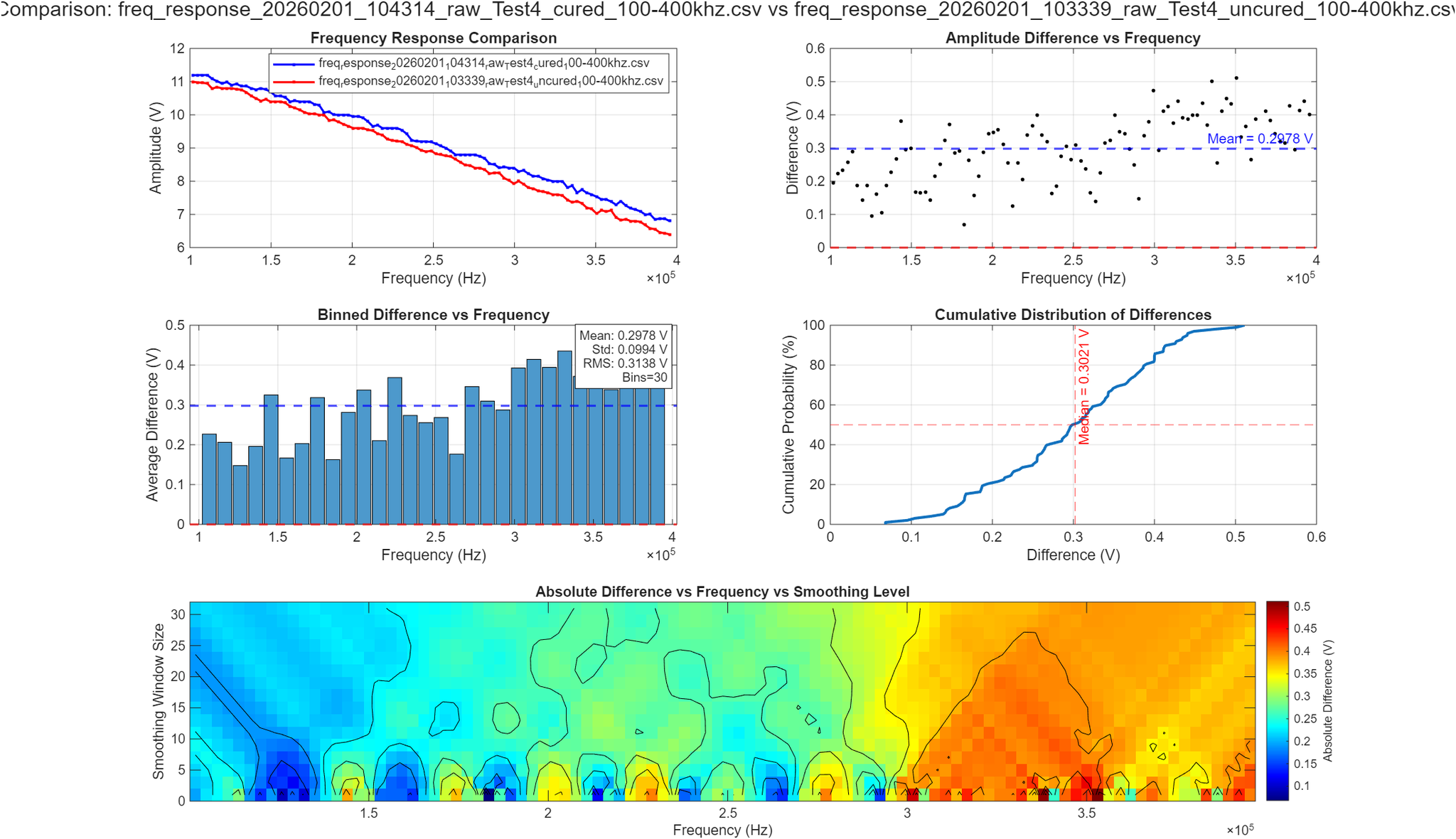
Our system successfully identified specific printing phases including layer start times, plunge cycles, cure progression, and print completion by analyzing phase offset and amplitude changes in a 245kHz test signal. The work demonstrated clear differentiation between cured and uncured resin states with voltage amplitude differences of up to 0.3V across the frequency spectrum.
FormLabs leadership showed real interest in the results and is supporting continued development, with an eye toward integrating this into their SLA printers for real-time print quality control and failure detection.
Role & Context
I served as team captain and handled all electrical engineering aspects of the project, working alongside Crawford Phillips, Mason Vogt, and Trevor McDonald. The team was invited to participate in FormLabs’ hackathon after previous research caught their attention.
My primary responsibilities included designing the impedance measurement system, developing the data collection pipeline, and running experiments with Mason. Crawford, Mason, and Trevor handled mechanical integration while Mason also created data visualizations in MATLAB. This was an R&D focused project with all work currently under wraps due to commercial sensitivity.
The motivation was to solve a fundamental challenge in SLA printing: there’s currently no way to monitor cure state in real-time during printing, leading to failed prints that aren’t detected until completion.
Tech Stack
- Hardware: Custom PCB with interdigitated electrode sensors, oscilloscope, waveform generator
- Signal Processing: 245kHz impedance analysis, phase and amplitude measurement
- Data Analysis: MATLAB for signal processing and visualization
- Integration: FormLabs SLA printer modification, custom build plate mounting
- Sensors: Multiple electrode geometries for different layer thicknesses
- Materials: UV-sensitive photopolymer resins, various cure states
Problem
SLA 3D printing relies on precise UV curing of liquid photopolymer resin, but there’s no real-time feedback on cure quality during printing. Failed prints are only discovered after completion, wasting time, materials, and energy.
Critical issues include:
- Incomplete curing leading to weak or failed parts with liquid resin layers that aren’t visible until removal
- Over-curing causing dimensional inaccuracy or brittleness
- Layer adhesion failures that aren’t detected until print completion
- Oxidation layer effects that impact surface quality
- Process optimization requiring manual trial-and-error approaches
Existing quality control methods are post-process only, providing no opportunity for real-time correction or early failure detection. The industry needed a non-invasive method to monitor cure state during active printing.
Approach / Architecture
Our approach centered on dielectric sensing using interdigitated electrode sensors integrated directly into the printer build plate. The system measures impedance changes as resin transitions from liquid to solid state during UV exposure.
The architecture consists of three main components:
Sensor Array: Custom PCB with multiple electrode geometries optimized for different layer thicknesses and cure detection sensitivity. Electrodes are positioned to make direct contact with resin during printing.
Signal Generation & Measurement: 245kHz test signal generated by waveform generator, with phase and amplitude response measured via oscilloscope. This frequency was selected for optimal sensitivity to resin dielectric property changes.
Data Pipeline: Real-time signal processing to extract cure state indicators from impedance measurements, with MATLAB-based analysis for pattern recognition and visualization.
Key Features
- Real-time cure monitoring during active SLA printing
- Multi-geometry sensor array for different layer thickness optimization
- Phase and amplitude analysis at 245kHz for maximum sensitivity
- Layer-by-layer detection of cure progression and timing
- Print phase identification including plunge cycles and layer starts
- Quantitative differentiation between cured and uncured states
- Non-invasive integration with existing FormLabs hardware
- Sub-second response time for rapid cure state changes
Technical Details
Sensor Design
I designed a custom PCB featuring multiple interdigitated electrode patterns with varying geometries. The electrodes create fringing electric fields that penetrate into the resin, allowing measurement of dielectric properties at different depths and sensitivities.
The sensor array included different comb spacings and electrode widths to optimize detection for various resin layer thicknesses. Smaller electrode spacing provided higher sensitivity for thin layers, while larger patterns offered better signal-to-noise ratios for bulk measurements.
Signal Processing
With the impedance analyzer delayed by a snowstorm, I adapted our measurement approach using an oscilloscope and waveform generator. The 245kHz test frequency was selected after preliminary testing showed optimal sensitivity to cure-state changes in this range.
Key measurements included:
- Phase offset between input and output signals
- Amplitude ratio (ΔV_pp) indicating impedance magnitude changes
- Frequency response across 100-400kHz range for characterization
Data Collection Results
Our experiments produced several breakthrough results using a systematic approach to sample preparation and measurement:
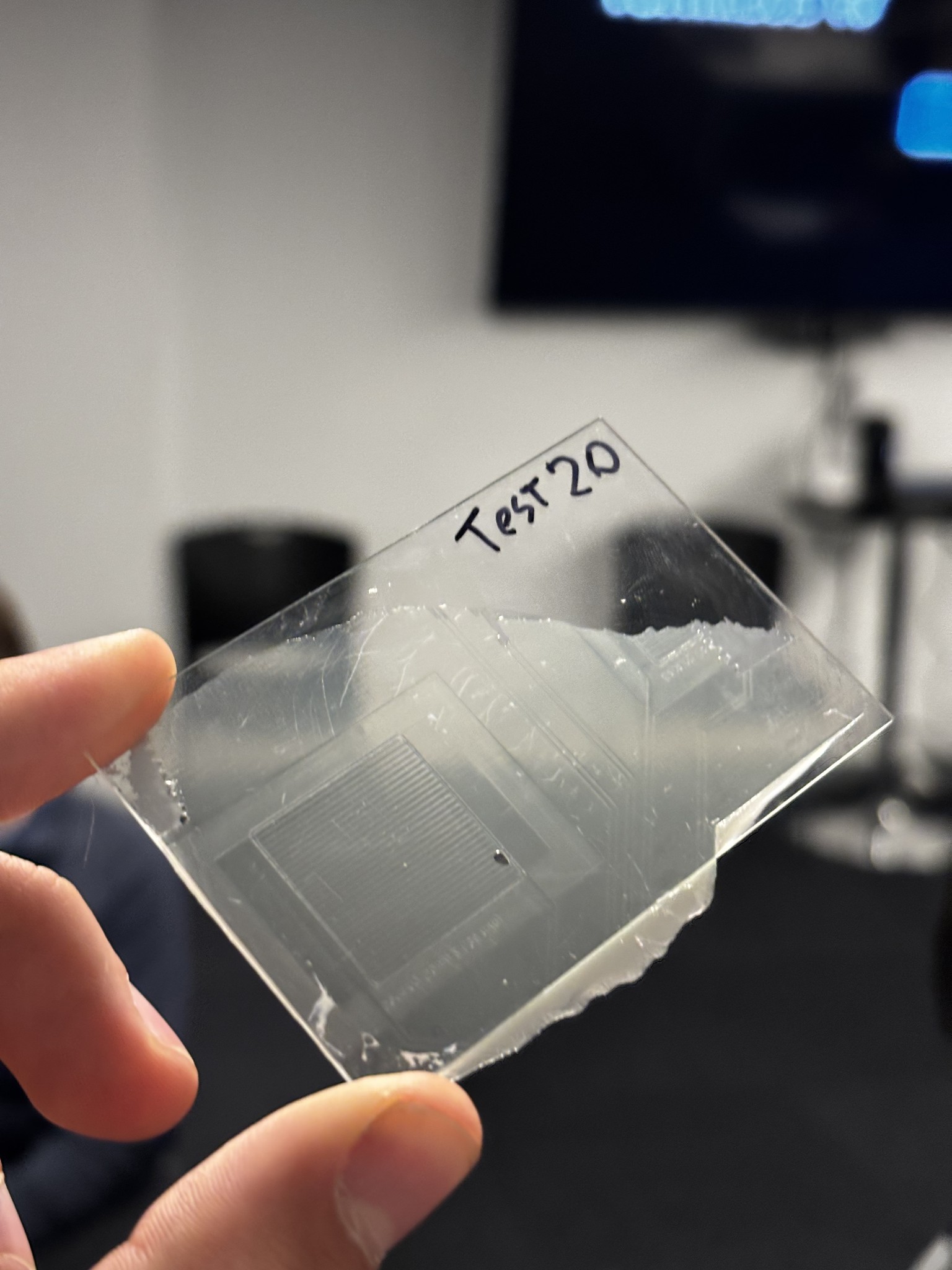
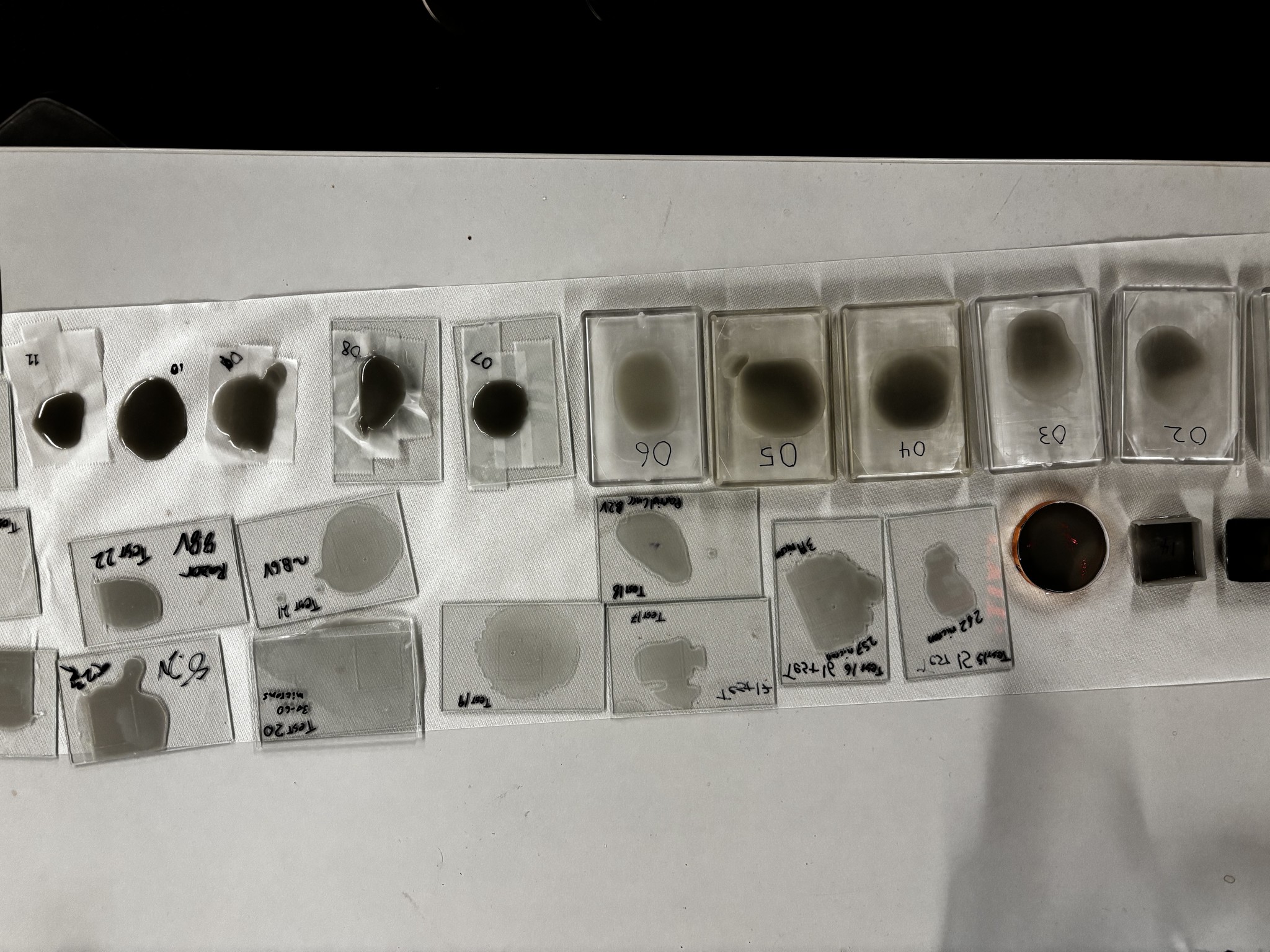
Sample Preparation: Glass slides were carefully applied over resin drops on the PCB to create uniform thickness samples for cure testing, ensuring consistent contact between the resin and electrode sensors.
Cured vs Uncured Differentiation: Clear amplitude differences of ~0.0078V mean between fully cured and uncured resin samples across the frequency spectrum, with peak differentiation around 200-300kHz.
Real-time Print Monitoring: Successfully tracked complete print cycles showing distinct voltage signatures for buildplate finishing, individual layer starts, and print completion over ~800-second print duration.
Cure Kinetics: Glass slide tests revealed real-time cure progression with voltage transitions occurring within seconds of UV exposure, demonstrating the system’s ability to detect cure state changes as they happen.
Integration Challenges
Mounting the sensor system required careful mechanical integration to avoid interfering with the SLA printing process. The PCB was integrated into a custom build plate that maintained proper resin contact while allowing normal printer operation.
Signal integrity was critical given the small voltage changes being measured. Proper shielding and grounding techniques were essential to minimize noise from the printer’s UV LED array and mechanical systems.
Results
The hackathon demonstrated clear proof-of-concept for real-time resin cure monitoring. Key quantitative results included:
- 0.3V amplitude differences between cure states in optimal frequency ranges
- Real-time detection of print phases with sub-second response times
- Successful integration with FormLabs hardware without process interference
- Multiple sensor validation across different electrode geometries
- Reproducible measurements across different resin samples and cure conditions
The work proved that dielectric sensing can reliably differentiate cure states and track cure progression in real-time during SLA printing. FormLabs leadership expressed strong interest in the technology’s commercial potential.
Lessons Learned
Hardware Adaptability: When our impedance analyzer didn’t arrive due to weather, quickly adapting to oscilloscope-based measurements taught me the importance of flexible experimental design and backup measurement approaches.
Frequency Selection: The 245kHz frequency proved optimal, but systematic frequency sweeps revealed that different cure states have distinct spectral signatures. Future work should explore multi-frequency analysis for more robust detection.
Integration Complexity: Real-world integration with commercial printers involves numerous mechanical and electrical constraints not apparent in benchtop testing. Early consideration of manufacturing and integration requirements is crucial.
Team Dynamics: Leading a multidisciplinary team under tight hackathon constraints reinforced the importance of clear role definition and regular communication, especially when combining EE and ME expertise.
Commercial Viability: The strong industry interest validated our technical approach but also highlighted the importance of IP considerations and commercial development pathways in R&D projects.