Autonomous Swarm
A four-vehicle autonomous drone swarm project, built in two stages: a single physical quadrotor (custom SLS/SLA-printed frame, offboard perception, PX4 flight stack) and a four-vehicle swarm coordination layer, currently proven out in Isaac Sim while the other three airframes are funded.
Overview
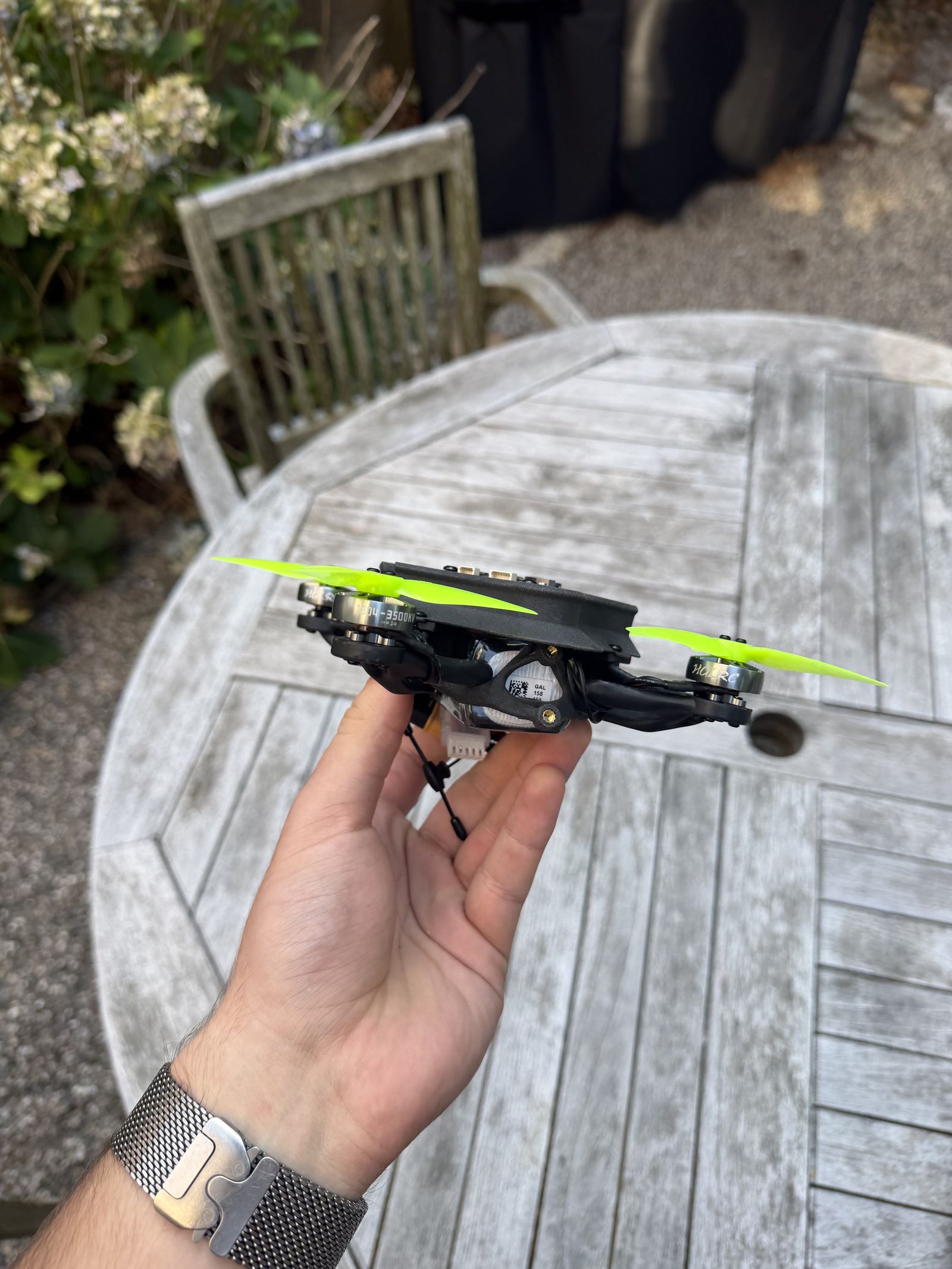
This project splits into two halves that are being developed in parallel: building one physical autonomous quadrotor, and proving out multi-vehicle swarm coordination in simulation. The end goal is a four-drone swarm that can map out an indoor room together. Right now, one physical drone is built and flying (autonomy tuning still in progress), the swarm layer is demonstrated with four vehicles in simulation, and the other three physical airframes are waiting on funding.
Frame & Mechanical Design
The frame went through two real design generations:
First pass was a straightforward flat-sheet-cut frame with standard mounting hardware for the FC/ESC stack and motors — functional, but not a design I felt I learned much from.
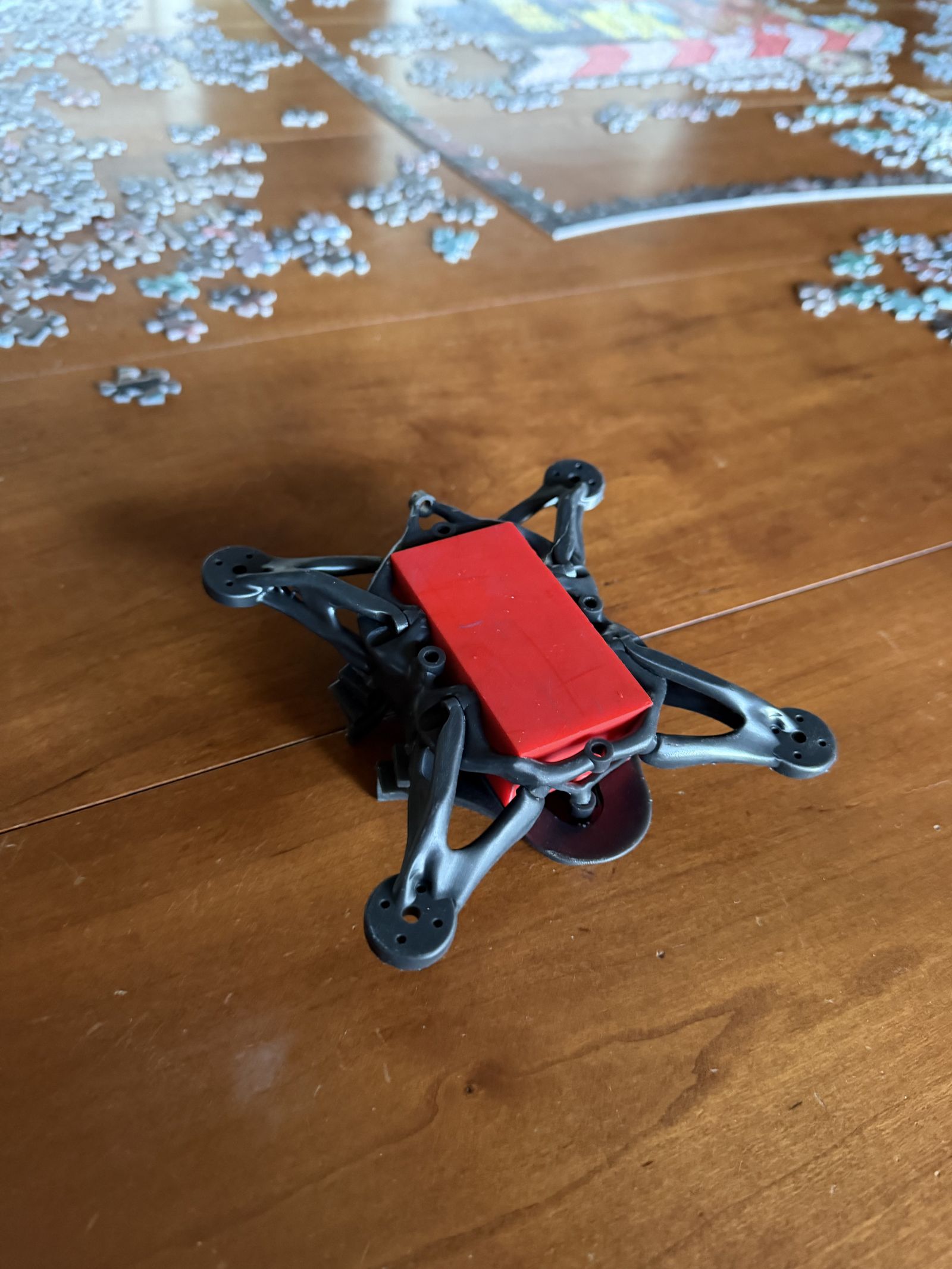
Second pass took advantage of being at Formlabs to prototype on their SLS printers instead. I ran the frame through Fusion 360’s generative design tool, targeting an impact-resistant structure that holds the motors on the center-of-mass line, under four independent load cases (static thrust, aggressive-maneuver thrust with a lateral component, motor torque reaction, and a crash/impact proxy at the arm tips). I also ran a separate modal-frequency simulation on the GD output, since generative design in Fusion doesn’t optimize for that on its own — the arm’s bending frequency needed to clear the full motor RPM sweep, not just cruise RPM.
The first printed frame was Tough 2000 (SLA, on a Form printer). It shattered on the first crash, so I switched the production frame to SLS-printed Nylon 12 — more flexible and impact-tolerant, at the cost of needing softer vibration isolation (grommets/standoffs) under the FC stack to compensate for the material’s flex compared to a rigid carbon frame.
Arms are separate, bolted pieces rather than a unibody print, so a crashed arm is a cheap individual reprint during autonomy tuning rather than a full-frame loss.
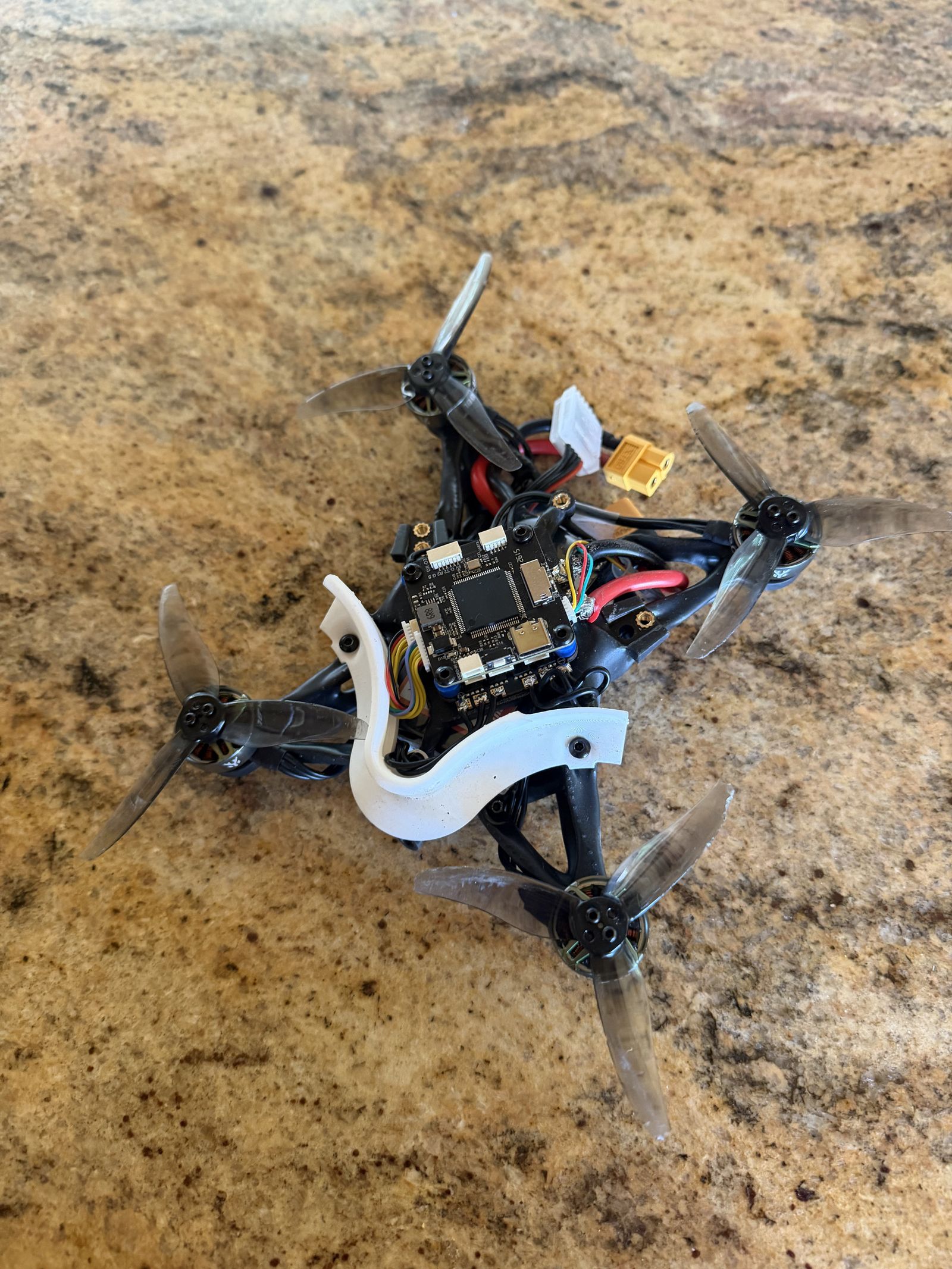
Prop guards — I designed two variants: one that shields just the flight controller/electronics, and one that rings the entire propeller for full protection. The controller-shielding guard (printed in Rigid 10K) has held up through the build so far. The full-ring guard broke the one time I tested it — it was printed in Fast Model resin, which turned out to be too rigid and brittle for an impact part. Next attempt will be SLS Nylon 12 or Tough 2000.
Perception & Sensing
- Global-shutter camera — an innomaker OV9281 (720p/120fps, USB/UVC) streams video off the drone to a ground PC for asynchronous visual SLAM. Global shutter avoids the rolling-shutter distortion that would otherwise corrupt fast-motion SLAM tracking.
- Optical flow + rangefinder — a MicoAir MTF-02P handles lateral position tracking and altitude via optical flow, working indoors and outdoors (rated to 70 klux), MAVLink over serial to the flight controller.
- Obstacle sensing (reflex layer) — a VL53L5CX 8×8 multi-zone ToF sensor provides fast, always-available obstacle avoidance that’s kept independent of the camera/SLAM stack, so a slow or dropped perception pipeline can’t take out basic collision avoidance with it.
Camera and ToF sensor are both mounted at a forward-and-down tilt matched to the drone’s assumed cruise pitch, so their fields of view agree on “forward” during aggressive flight rather than during hover.
Flight Stack
| Component | Part | Notes |
|---|---|---|
| FC + ESC | AERO SELFIE H743 (STM32H743, dual IMU, integrated 60A 4-in-1 ESC) | Official PX4 support; 7 UART for the camera link, optical flow sensor, and RC receiver on separate buses |
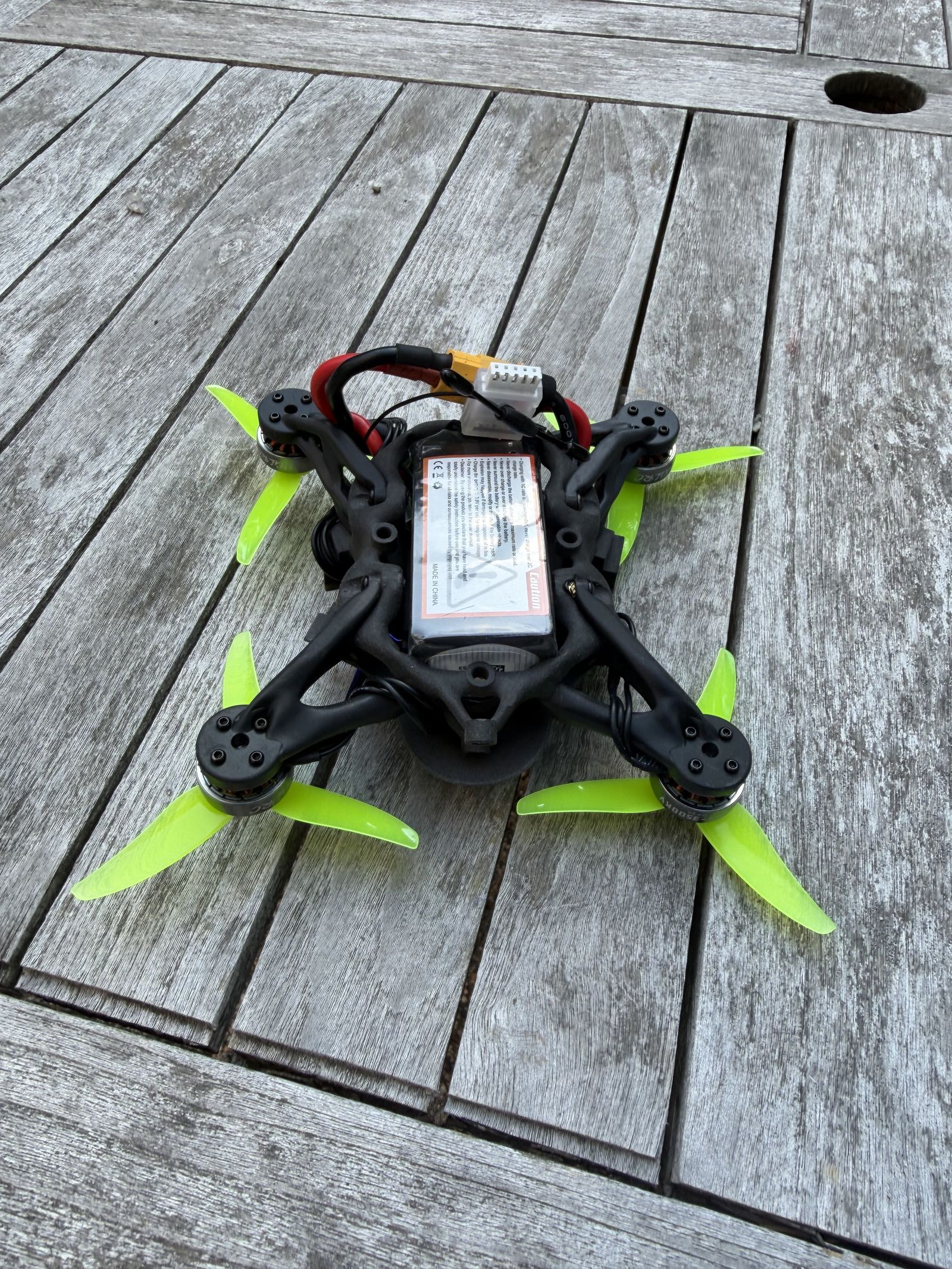
| Motors | HGLRC Specter 1804-3500KV ×4 | Sized for 3-3.5” props on 4S |
| Props | Gemfan Hurricane 3520, 3-blade | Chosen small (3.5”) specifically to keep the drone compact for indoor room-mapping |
| Battery | Ovonic 4S 1300mAh 120C | ~156g per pack |
| RC link | RadioMaster Pocket (ELRS) + RP1 receiver | Wired to a UART kept separate from the camera/telemetry link, so the manual-override safety path doesn’t share a failure mode with the autonomy data link |
| Companion computer | Raspberry Pi Zero 2 W | Bridges MAVLink telemetry and camera capture over WiFi |
The architecture keeps flight stabilization (rate/attitude PID) onboard the FC regardless of link status, with the camera/SLAM compute offloaded to a ground PC — and an onboard dead-reckoning failsafe (IMU + optical flow) to hold position briefly if that link drops. The design principle throughout: the fast, safety-critical loops never depend on a link or subsystem that can fail independently.
Aggressive autonomous maneuvering (the drone flying and pitching hard
under computer control, not hand-flown) is commanded through PX4’s MAVSDK
Offboard API rather than manual sticks, with MPC_TILTMAX_AIR raised
past its conservative default to allow steeper commanded pitch.
One design constraint I’ve been idly considering (untested, just a for-fun challenge with a friend, not something I’ve built or tried) is whether the same maneuverability-first architecture — favoring acceleration and redirection over top speed — would also help evade a tracked laser dazzle threat, purely through unpredictable flight paths rather than any hardening against the beam itself. It hasn’t shaped any implementation yet, but it’s part of why maneuverability was prioritized over top speed from the start.
Swarm Simulation
The multi-vehicle side runs in Isaac Sim + Pegasus Simulator + PX4
SITL, with each simulated vehicle controlled over MAVSDK from Python.
Working today: four-vehicle concurrent autonomous flight in
simulation — each vehicle gets its own gRPC port and PX4 SITL instance,
armed only after polling real vehicle-health telemetry rather than a
fixed timer, with asyncio.gather() running one control task per vehicle
concurrently. That concurrency pattern is the first real piece of swarm
coordination logic (not just a synchronized-takeoff demo), and the plan
is to extend it into actual search/task-allocation behavior for the room
mapping goal.
Status
Working:
- One physical quadrotor built and flying.
- Four-vehicle concurrent autonomous flight in simulation.
- Controller-shielding prop guard (Rigid 10K) validated through normal build/crash cycles.
In progress:
- Autonomous flight on the physical drone has been rough so far — currently retuning the PID loops and correcting weight distribution.
- Costing down the current drone, focused on the flight controller choice, since the other three airframes aren’t funded yet.
- Full-ring prop guard: redesigning in a tougher material (SLS Nylon 12 or Tough 2000) after the first attempt broke.
Media
Frame prototypes:
Final prototype:
First flight: