YBCO Superconductors
YBa₂Cu₃O₇ ceramic pellets made by solid-state synthesis, then cooled in liquid nitrogen to levitate a magnet (the Meissner effect) and measured with a four-terminal probe. EDS showed the composition missed the 1:2:3 target, which sets up the next batch. A team lab for Olin materials science.
Overview
YBCO (yttrium barium copper oxide) is a high-temperature superconductor: below about 93 K, warmer than liquid nitrogen’s 77 K, it carries current with no measurable voltage drop and expels magnetic fields. We made YBCO pellets from powders, then tested whether they superconducted.
This was a team lab with Aryan Banerjee, Ben Rha and Zahra Lari (Team BIZA) for Olin’s materials science course. We shared fabrication, testing and analysis.
Results:
- Levitation: a magnet stayed suspended above a pellet cooled in liquid nitrogen, the Meissner effect.
- Resistance: four-terminal resistance fell from about 4.8 mΩ near 158 K to about 1.2 mΩ at 84 K, the coldest point recorded, dropping fastest below about 100 K. It never reached zero.
- Composition: EDS measured roughly 13 : 43 : 44 atomic % Y : Ba : Cu, against 17 : 33 : 50 for the 1 : 2 : 3 target. The pellets were barium-rich and short on yttrium and copper.
Why Structure Matters
YBCO’s metals sit in a fixed 1 : 2 : 3 ratio of Y : Ba : Cu. When fully oxygenated, the crystal is orthorhombic, with unequal a and b lattice parameters, CuO₂ planes and Cu–O chains. That structure is what supports superconductivity. If oxygen content drops, the lattice shifts to a tetragonal form that doesn’t superconduct. Both the metal ratio and the oxygen content have to be right.
Fabrication
- Mix: ground BaCO₃, Y₂O₃ and CuO together for 1 hour.
- Press: added a few drops of 4 wt% PVA binder, loaded the die, and compacted the powder in an Instron.
- Sinter: heated the pellets to 930 °C and held for 10 hours, ramping up and down at 5 °C/min, about 16 hours in the furnace in total.
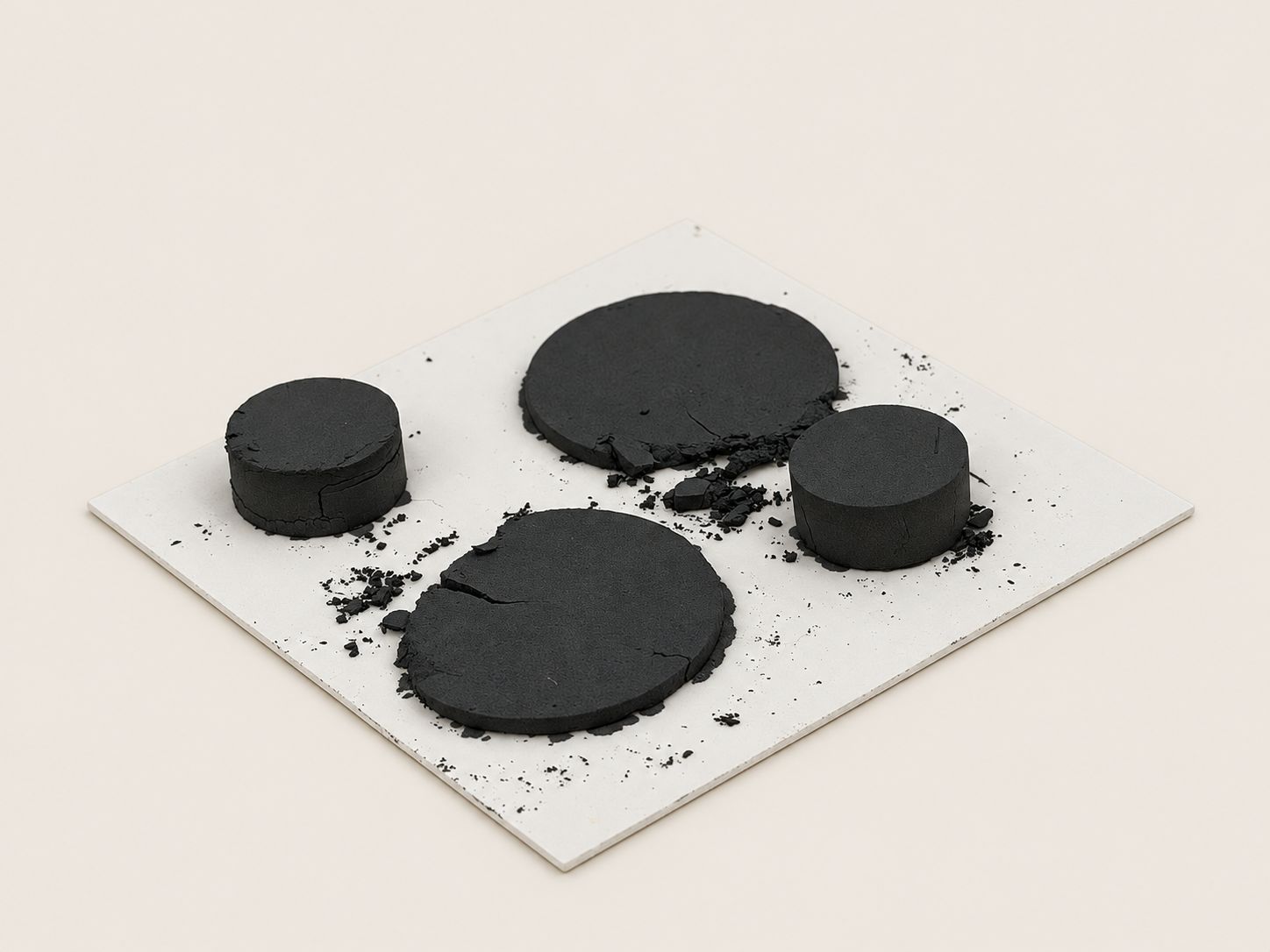
The pellets came out fragile after pressing, a sign the binder wasn’t enough to hold the powder together.
Sintered pellets. Two have cracked, and loose powder has broken off the edges.
Testing
Meissner effect
We submerged a pellet in liquid nitrogen and placed a magnet above it. The magnet stayed suspended over the pellet, the clearest evidence that at least part of the pellet went superconducting.
The magnet levitating above the cooled pellet.
Placing the magnet with tweezers over the pellet in liquid nitrogen.
Four-terminal resistance
Four silver contacts on the pellet separated the current-source leads from the voltage-sense leads, so contact and lead resistance don’t show up in the reading. A thermocouple on the pellet surface logged temperature while the pellet warmed from liquid-nitrogen temperature.
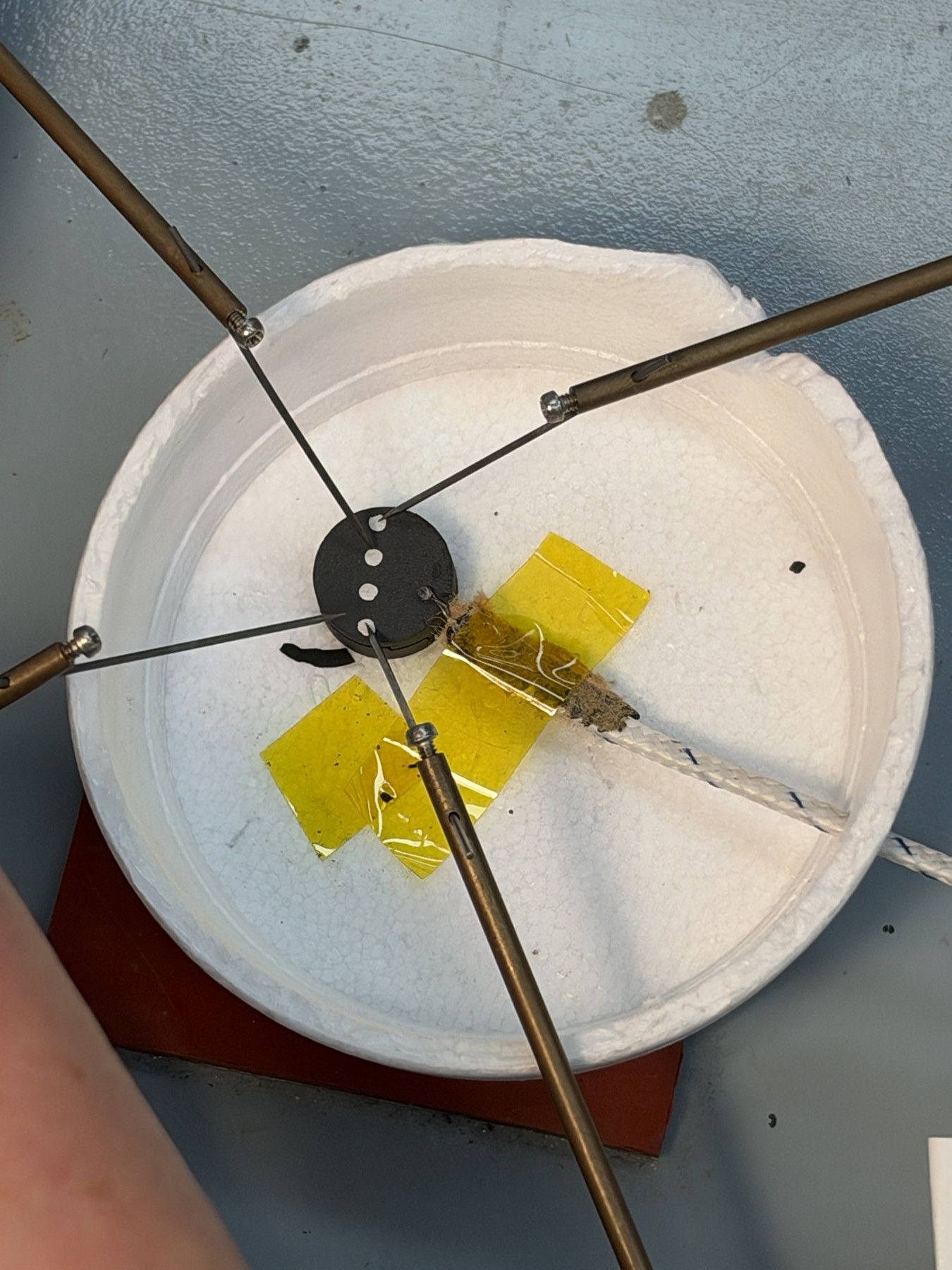
Four-point probe and thermocouple on the pellet.
Resistance fell from about 4.8 mΩ near 158 K to about 1.2 mΩ at 84 K, the coldest point we recorded, and dropped fastest below about 100 K. It never reached zero, so the resistance data supports superconductivity less directly than the levitation test does.
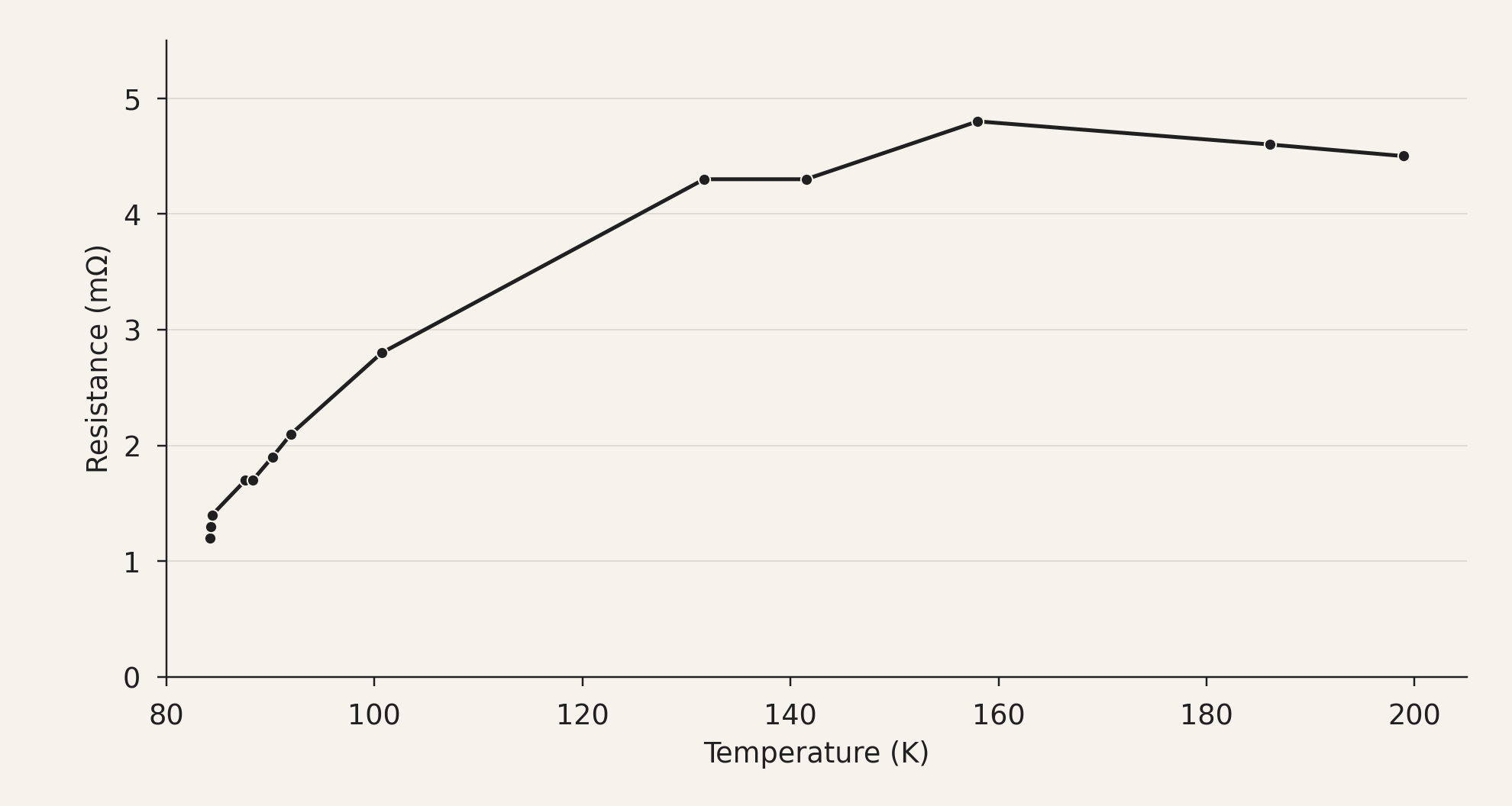
Four-terminal resistance while the pellet warmed.
Composition and structure
- SEM / EDS (10 kV) showed a granular surface with larger features and darker gaps between them. EDS on that region gave Y : Ba : Cu of 13.0 : 43.2 : 43.9 atomic %, normalized over the three metals. The spectrum also shows oxygen and a small carbon peak.
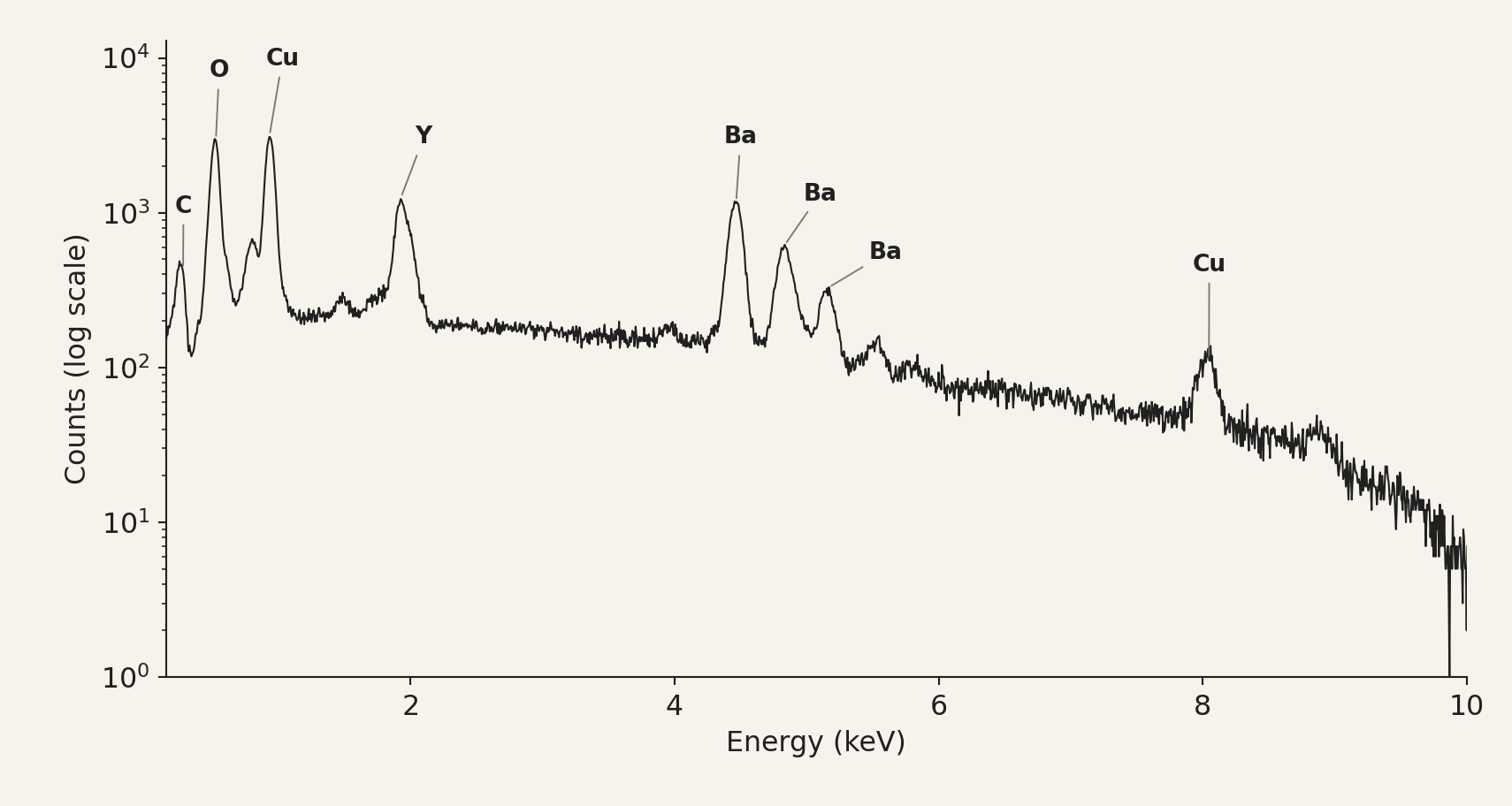
EDS spectrum at 10 kV.
- XRD (powder, Cu source at 40 kV / 30 mA, 2θ from 20° to 80°, 0.02° steps) showed distinct diffraction peaks.
What We’d Change
- Composition: the measured ratio missed 1 : 2 : 3. Ball milling, or another more thorough mixing method, should give a more uniform powder.
- Strength: use more binder so pellets survive handling after pressing.